

Your token launched with real promise. The smart contract is solid, the community is forming, and the roadmap looks sharp. Yet something feels off. The charts are quiet, the order book is thin, and traders scroll past your listing without a second look.
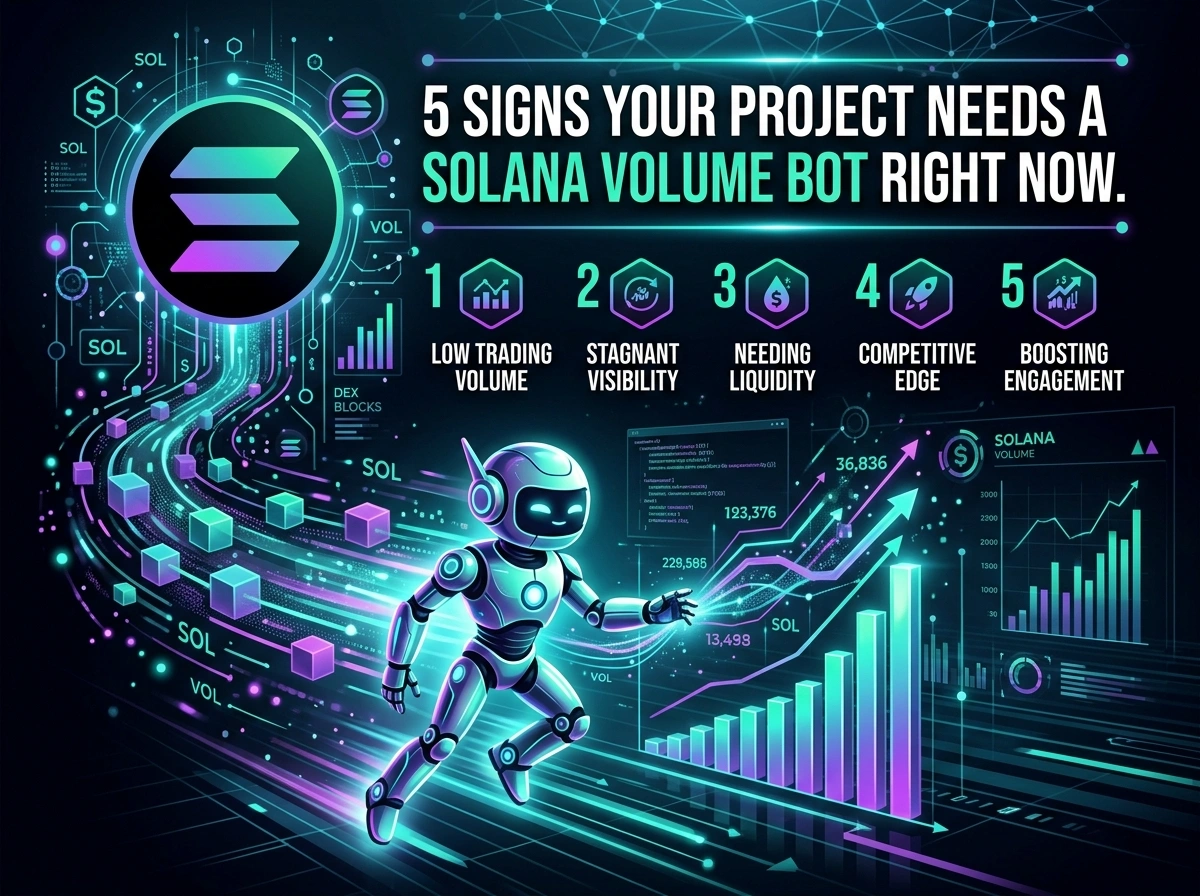
If that sounds familiar, you may be facing a visibility problem rather than a product problem. In this article, you’ll learn the five clear warning signs that your Solana project needs a volume strategy, why each sign matters, and what you can do about it. We’ll cover low trading volume, weak DEX screener presence, missing organic activity, investor and liquidity struggles, and the danger of falling behind your competition.
Let’s break down the signals you shouldn’t ignore.
Sign 1: Your Trading Volume Is Flat or Falling
Low volume is the first red flag, and it’s usually the loudest.
When a token barely moves, traders assume nothing is happening. Volume is the heartbeat of any market. It tells people that buyers and sellers are active, that prices are being discovered, and that the asset is alive. A flat volume chart sends the opposite message: stagnation.
Here’s why this matters on Solana specifically. The ecosystem moves fast, with new tokens launching daily. Traders make snap decisions, and one of the first metrics they check is 24-hour volume. If yours sits near zero, you’re invisible before you even get a chance to make your pitch.
Watch for these patterns:
- Daily volume that keeps shrinking week over week
- Long stretches with no transactions at all
- A spike at launch followed by total silence
If you’re seeing these signs, it usually means your token isn’t generating enough activity to attract attention on its own. A solana volume bot can help maintain consistent on-chain activity, keeping your charts active so real traders take a closer look.
Ask yourself: when someone lands on your token page, does the volume tell a story of momentum or one of neglect?
Sign 2: Your Token Is Invisible on DEX Screeners
Poor visibility on screeners like DEX trackers is a silent killer for new projects.
Most Solana traders discover tokens through screening tools that rank assets by volume, transaction count, and recent activity. These platforms sort projects by what’s trending. If your token doesn’t meet the minimum activity thresholds, it never appears in the lists people actually scroll through.
Think about how discovery really works. A trader opens a screener, filters by recent volume, and browses the top results. Tokens with healthy activity rise to the top. Tokens with dead charts sink out of sight. No matter how good your fundamentals are, you can’t convert a trader who never sees you.
Signs your screener presence is weak:
- Your token doesn’t show up in trending or “hot pairs” sections
- You fail to meet volume filters that traders commonly use
- Your listing looks abandoned compared to active competitors
This is where consistent activity changes the game. Screeners reward movement. When your token shows steady transactions and volume, it climbs into visible ranges where curious traders can find you organically.
Try this: search for your token the way a stranger would, using common filters. If you can’t find yourself in a few clicks, neither can your future investors.
Sign 3: There’s No Organic Market Activity
A quiet market scares people away, even when the project is sound.
Organic activity is the natural buying, selling, and trading that happens when a community is genuinely engaged. It’s hard to fake confidence, but it’s easy to spot the absence of it. When a token shows zero movement for hours or days, visitors assume the project is dead or, worse, a rug.
This creates a frustrating cycle. Traders won’t buy because there’s no activity, and there’s no activity because traders won’t buy. Breaking that loop is one of the hardest challenges for early-stage Solana projects. You need to show signs of life before organic interest can build momentum.
Common symptoms of a dead market:
- Hours pass with no new transactions
- The community asks “is this project still active?”
- Holders grow nervous and start selling out of fear
Consistent baseline activity addresses this directly. It signals that the token is in motion, which reassures existing holders and invites new participation. Once people see movement, they’re far more likely to jump in and add genuine, organic trades on top.
Here’s the contrast worth remembering: a market that looks active attracts more activity, while a market that looks dead drives even loyal holders away.
Sign 4: You’re Struggling to Attract Investors and Liquidity
If investors keep passing on your project, low activity is often the reason.
Serious investors and liquidity providers do their homework. Before committing capital, they study your volume trends, holder distribution, and trading patterns. A thin, inactive market signals high risk. They worry about slippage, exit liquidity, and whether they can move in and out without crashing the price.
Liquidity follows confidence. When your token shows healthy, consistent trading, providers feel safer adding to pools. Larger pools mean tighter spreads, which makes the token more attractive to the next wave of traders. It’s a positive flywheel, but it only spins when there’s enough activity to start it.
You may have an investor problem if:
- Potential backers cite “low volume” or “no liquidity” as reasons to pass
- Your liquidity pool stays small and stagnant
- Big buys cause massive price swings due to thin order books
Building steady volume helps you present a healthier profile to the people who matter. It shows that the market can absorb trades, that exits are realistic, and that the project has traction worth backing.
Ask yourself: if an investor evaluated your token today, would your activity inspire confidence or trigger caution?
Sign 5: You’re Falling Behind Your Competitors
Standing still in a fast-moving ecosystem means falling behind.
Solana hosts thousands of tokens, and new ones launch constantly. Your competitors aren’t waiting. They’re actively building visibility, climbing screeners, and capturing the attention you both want. Every day your token sits quiet, a similar project with stronger activity grabs the spotlight and the traders that come with it.
This is about momentum and mindshare. Attention in crypto is scarce and fast-moving. When two projects offer similar value, the one that looks more active almost always wins the trader’s click, the community member’s join, and the investor’s deposit. Visibility compounds, and so does invisibility.
Signs you’re losing the race:
- Similar projects consistently rank above you on screeners
- Your community engagement lags behind comparable tokens
- Newer launches overtake you in volume within days
The goal isn’t to fake success forever. It’s to give your project a fair shot at being seen during the critical early window. Consistent activity levels the playing field, helping you compete for attention while your fundamentals and community do the long-term heavy lifting.
Try this: pick three direct competitors and compare your volume and screener ranking side by side. The gap will tell you exactly where you stand.
Conclusion: Don’t Let a Quiet Market Bury a Strong Project
The five signs are clear: flat trading volume, weak screener presence, no organic activity, investor hesitation, and losing ground to competitors. Each one points to the same root issue. A great Solana project can fail simply because no one notices it in time.
Visibility and activity are not luxuries in crypto. They’re the foundation that lets your real value reach the people who’ll champion it. If you recognized your project in two or more of these signs, now is the moment to act, not after another month of silence.
Your next step is simple. Audit your token’s current volume and screener ranking today, compare it against your top competitors, and decide whether a consistent activity strategy can give your project the visibility it deserves. The window for early traction doesn’t stay open forever, so move while it counts.